Why are volunteer blood stem cell donors needed?

Healthy blood stem cells from a compatible volunteer donor can cure leukemia.

A stem cell transplant is only possible once a suitable donor has been found. For a peripheral blood stem cell or bone marrow transplant to be successful, the tissue types must match 100 percent, ideally. The probability that two unrelated individuals will have identical tissue characteristics is very low. Depending on the tissue type, the odds range from 1 in 30,000 to well over 1 in several hundred million. Therefore, a suitable donor can only be found if there is a very large pool of bone marrow and stem cell donors.

Through global cooperation, the chances of finding a suitable donor for every patient can be increased. The global pool of registered stem cell donors makes it possible to quickly and promptly match a leukemia patient with a suitable donor. Without the global donor registry, the search for a donor would take too long and would come too late for most patients.

A cheek swab or a blood sample—which is needed for genotyping?

As a rule, swabbing the inside of the cheek is sufficient to determine all necessary parameters from the cells collected: HLA types, blood type, and CMV status. The AKB Foundation’s life-saving kit contains two buccal swabs.

Only when new stem cell donors are registered during blood donation are these parameters determined from a blood sample. Since an IV line is already in place for the blood donation, only one additional blood tube needs to be filled for typing.

What happens to my cheek swab or blood sample?

The tissue characteristics of donors are determined from buccal swab or blood samples in a specialized laboratory. These tissue characteristics are a fundamental component of the immune system. They distinguish between “foreign” and “non-foreign” and determine whether a donor is suitable for a patient. These characteristics, described using numbers and letter combinations, are made available to matching centers in pseudonymized form, enabling transplant surgeons around the world to select suitable donors.

What are the health requirements for registering as a stem cell donor?

There are a number of restrictions and exclusion criteria that would result in disqualification from stem cell donation and that must be reviewed BEFORE you register as a stem cell donor. Please read the list carefully before registering.

Exclusion Criteria

What is the preliminary examination, and what happens during it?

Before each blood stem cell donation, a thorough medical examination and an informational consultation with an AKB physician take place.

The examinations include:

  • physical examination
  • ECG

  • ultrasound examination of the liver, spleen, and kidneys
  • X-ray of the lungs and heart
  • blood draw for further laboratory tests
  • additional examinations, if necessary
  • personal consultation with a doctor

These tests are intended to rule out any health risks to both the donor and the patient.

The AKB physician advises and informs the donor in order to discuss and address any concerns they may have. Each donor is made aware of the great responsibility they assume by giving their consent to donate. The patient is inevitably dependent on the stem cell donation and relies on the donor’s reliability.

All results from the preliminary examination are provided on the day of the donation for the donor’s own records or for their primary care physician.

How does blood stem cell donation work? Are there any risks involved?

The patient’s treating physician determines which method of stem cell collection will be used.
There are two types of blood stem cell donation:

PERIPHERAL BLOOD STEM CELL DONATION:

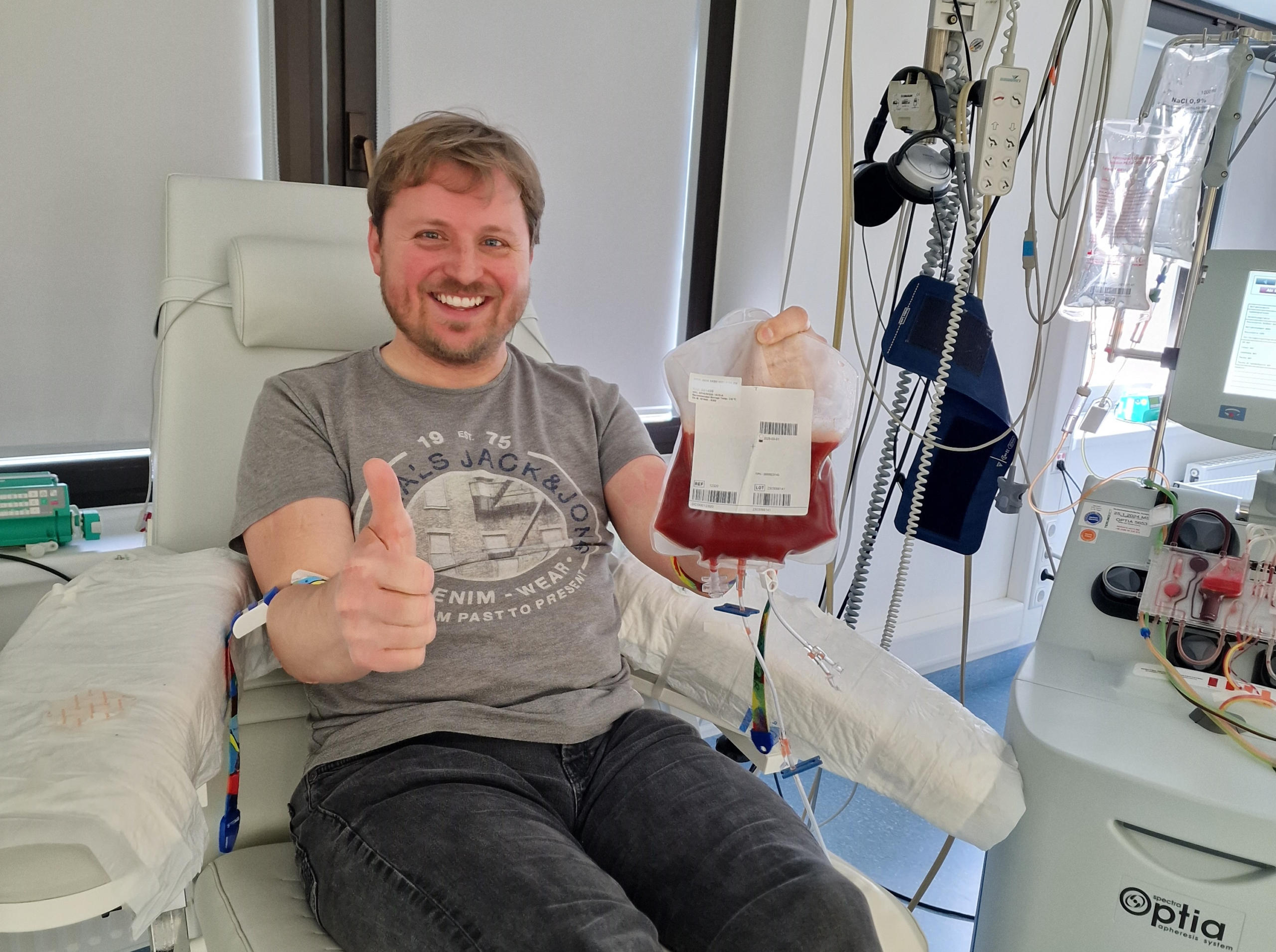
With this collection method, a medication that stimulates increased stem cell production is administered over four days. This is done using small injections that donors can administer to themselves at home. Each donor receives instructions on how to do this during the pre-donation screening appointment. Following this mobilization, the stem cells circulating in the blood are collected via a vein in the arm on the fifth day. The donation takes place in the outpatient clinic of the AKB Foundation under the supervision of the doctors whom the donor has already met during the pre-donation examination. The donation process takes about 4–5 hours. Side effects during the preparation period include flu-like symptoms such as bone, joint, and muscle pain, as well as possible headaches and nausea. These symptoms can be effectively treated with pain relievers and subside immediately after the procedure is completed. No long-term effects of this method have been reported since it was first used in 1989.

In rare cases, allergic reactions may occur when the medication is administered or when stem cells are collected from peripheral blood.

The collection of stem cells does not impair the donor’s own immune system.
 

BONE MARROW DONATION:

The procedure is performed under general anesthesia and takes about one hour. You can leave the clinic the very next morning. No pre-procedure medication is necessary. Needles are used to puncture the iliac crest. The punctures leave one to two small marks on each side of the iliac crest, but these do not leave visible scars. Side effects include minor blood loss and muscle soreness in the upper gluteal muscles. Heavy lifting should be avoided for about 14 days after the bone marrow donation.

The health risks associated with bone marrow collection are low. It is essentially limited to the general risks associated with any surgical procedure performed under anesthesia (infection, bruising, wound healing complications). The bone marrow itself regenerates quickly, so no health complications are expected as a result.

To rule out any avoidable risks, every donor undergoes a thorough pre-donation medical examination. Only completely healthy individuals are approved as donors.

The stem cell collection does not compromise the donor’s own immune system.

To avoid any misunderstandings: Blood stem cells are found in the bone marrow. The spinal cord in the spinal canal has nothing to do with this.

How is the anonymity of the donation ensured, and how long must it be maintained?

Throughout all processing and manufacturing procedures, the anonymity of the donor and the patient is strictly maintained from unauthorized parties. Key measures to ensure this include:

    • Only the necessary personal data of the donor and the patient may be disclosed to the respective authorized institutions for the purpose of carrying out the stem cell donation (donor registry, collection unit).
    • All information concerning the donor that is disclosed to outside parties must not contain any names, but only pseudonymized codes.
    • After the collection or transplantation, donors or patients may be informed of the partner’s gender and approximate information regarding the partner’s origin and age only upon request, in a manner that does not compromise anonymity.

The transplant unit is specifically responsible for keeping the donor’s data (such as the donor identification number and date of birth) confidential from the patient to the greatest extent possible (e.g., by covering the required product labels).

After the transplant has been performed, anonymous correspondence between the donor and the patient is permitted. The ZKRD, the donor registry, and the transplant unit review the correspondence for any information that could reveal the identity of the donor or the patient. Such information must be redacted or removed before the correspondence is forwarded.

Direct contact between a donor and a patient or is permitted no earlier than two years after the first transplant, provided that both parties have been informed of the advantages and disadvantages of direct contact by the donor registry (for the donor) or the transplant unit (for the patient), and both the donor and the patient or the patient’s legal representative have signed a corresponding consent form. If the patient receives another transplant from this donor, direct contact is possible no sooner than one year after the retransplant. It is recommended that at least one written exchange take place between the donor and the recipient before anonymity is lifted. The timing of the retransplant does not shorten the initial two-year period.

Direct contact between the family members of a deceased patient and the patient’s donor is possible without observing a waiting period if both parties have been informed and have signed a corresponding consent form. If third parties wish to waive anonymity after the death of the patient or donor, the family members of the patient or donor must also give their consent.

Whether and what kind of contact is possible depends on the specific countries from which the patient and donor come. In many countries, including Germany, it is possible for the patient and donor to meet. In some countries, the prerequisite for personal contact is prior, regular, anonymous written communication. However, this is generally only considered if both the donor and the patient expressly consent and if more than two years have passed since the transplant. For various reasons, such encounters can be somewhat problematic and, if arranged, are handled with appropriate sensitivity. Of course, there is no entitlement to personal contact.

Is there compensation for stem cell donation?

In accordance with legal requirements, stem cell donation is provided free of charge. However, all expenses (travel, lodging, lost wages, etc.) are reimbursed.

Am I covered by insurance during the stem cell donation?

All stem cell donors are covered by statutory insurance under the law, known as GUV (Statutory Accident Insurance). The responsible accident insurance provider depends on the location where the collection takes place. For stem cell donors of the AKB Foundation, this is the municipality of Gauting. In addition to the GUV, private accident insurance is taken out for each donor, at no cost to the donor, of course.

These insurance policies provide donors with comprehensive coverage under insurance law during the pre-donation screening, during the donation itself, and in the period following the donation. Furthermore, the insurance coverage applies in the event of an accident occurring while traveling to and from the pre-donation screening or the donation.

As part of the pre-donation screening, each donor is provided with detailed information about the insurance coverage.

Can I withdraw my consent to donate stem cells?

Registration as a stem cell donor is always voluntary, and everyone has the right to withdraw at any time and have their data deleted from the database. Consent may be revoked at any time informally and without providing a reason. The revocation may be submitted informally by email, mail, or fax.

Consent to donate stem cells to an unrelated person with a medical condition is reconfirmed both during the confirmatory typing phase and during the pre-donation screening. Everyone has the right to revoke their consent at any stage of the process and to withdraw from the donation.

Everyone should carefully consider whether they truly want to donate stem cells when they register. Registration costs money, which must be funded by donations. If a donor is already on the shortlist for a specific patient and then withdraws, it dashes the hopes of the patient and their treatment team that there is a potential lifesaver. However, it can have fatal consequences if the withdrawal is announced after the preliminary examination or shortly before the donation. Due to the pre-transplant treatment, the patient’s immune system is in an extremely critical condition, and the patient is therefore inevitably dependent on receiving the donor cells. Without the life-saving stem cells, the patient’s life is in grave danger. Thorough education and open discussions with every donor are intended to prevent such situations from arising in the first place.

Can I register on behalf of a specific person?

Registration with the intention of making a matched blood stem cell donation to a specific patient is not permitted. Anyone who registers as a stem cell donor makes themselves available as a donor to all patients worldwide.

What happens to the results of my HLA test?

The tissue characteristics and, if applicable, other important laboratory findings (e.g., blood type or CMV status) are forwarded in pseudonymized form (using an encrypted identification number: assigned only the donor number without any personal data) to the Central Bone Marrow Donor Registry of Germany (ZKRD) and, consequently, to the global donor registry. The data is available to all transplant physicians and patient search units around the world. The database is continuously updated.

Is it a good idea to register with multiple stem cell donor registries?

Duplicate registrations make no sense. Anyone who has registered as a donor with a specific donor registry remains in the database until they turn 60. All organizations have access to the same global donor network, so it is sufficient to register with just one organization. Anyone who is already registered as a stem cell donor should not register with another registry as well.

On the contrary, duplicate registrations cause confusion and incur additional costs, since a donor registered twice is listed twice in the donor network and, in the event of a match, would be contacted by two different registries for the same patient. This must be avoided.

Register online now and get your life-saving kit